The Straight Answer: You Cannot Withdraw Money From Crypto Cosmic
You cannot withdraw money from CryptoCosmic — there is nothing to withdraw. Every coin, every balance, every profit you see in the app is virtual game currency, and the official Terms of Use state plainly that the game "does not contain any real-world cash or real cryptocurrency mechanics and is fully virtual". No balance in the app will ever reach a bank card, no wallet address will ever receive a payout, and no support ticket will change that.
We have been auditing crypto platforms since 2017, and if you searched "how to withdraw money from crypto cosmic", you deserve the truth in the first paragraph, not after two thousand words of filler. CryptoCosmic Trading Simulator is an educational game published on Google Play by Cosmic Champions (legal entity Smarteq Technology FZE LLC, per the official Terms). According to the official Google Play listing it sits in the "Educational" game category with a PEGI 3 rating — the same rating as a colouring-book app; no real financial product could carry it. There is no deposit system, no KYC, no withdrawal queue, no payment processor behind it. If you want the full picture of what the app actually is, we broke it down in our "what is CryptoCosmic" explainer.
That is the whole answer to the literal question. The rest of this page covers two things that matter far more: how the "CryptoCosmic payout" scams work — because they are actively hunting people who type this exact search — and how withdrawing crypto works on real, regulated platforms, which is the knowledge you were probably looking for in the first place.
Why So Many People Search for a Crypto Cosmic Withdrawal
This search exists for two reasons, and only one of them is innocent.
Reason one: the app feels real
CryptoCosmic streams real-time market prices into a simulated exchange. Per the official listing, you trade against live charts, complete missions, climb a leaderboard and enter trading competitions. When your virtual portfolio doubles because Bitcoin actually pumped that week, your brain files it under "money I made". But the profit is scenery, like poker chips in a video game.
Reason two: people are lying to you on purpose
Search YouTube or TikTok for "CryptoCosmic withdrawal" and you will find videos claiming the app pays out. You will also find websites — none of them the official cryptocosmicapp.com, which has exactly three pages and no login or dashboard — offering a "CryptoCosmic payout portal". These are not confused fans. They are scam operations built to monetise this exact search query.
The anatomy is always the same. The fake site shows you a "balance" (sometimes it asks you to enter the balance from your game, which it happily accepts). Then it asks for one of three things before it will "release" the funds:
- A "withdrawal fee" or "gas fee" — usually 20–100 dollars in crypto, sent to their address. You pay, they vanish, or they invent a second fee.
- Your card number and CVV — "to send you the payout". They are collecting card data for fraud, full stop.
- Your
seed phrase— "to connect your wallet". Anyone who has your seed phrase owns everything in that wallet, permanently.
Anyone who asks you to pay a fee to release winnings is committing fraud. This is true universally, not just here. The developer of CryptoCosmic has no payout system at all — so any site, video, Telegram admin or "support agent" promising a CryptoCosmic withdrawal is a scam by definition. There is no edge case. There is no exception.
The red-flag checklist
Screenshot this. It applies to every "payout" pitch you will ever see:
- A fee is required before you receive money — fraud. Real platforms deduct fees from the withdrawal itself.
- The site asks for your seed phrase — fraud. No legitimate service ever needs it.
- The domain is not the official one — for CryptoCosmic, anything other than cryptocosmicapp.com is unofficial, and even the official site has no login. We covered the fake-login problem in our login and sign-up guide.
- You are contacted first — in comments, DMs, or a "helpful" reply under a video.
- Urgency: "your balance expires in 24 hours". Real money does not expire on a countdown timer.
What You Actually Earn in the App
To be fair to the game: you do earn things in CryptoCosmic — they are just not money. Per the official Google Play listing, the app gives you virtual rewards for missions and tasks, achievements, leaderboard rank, and entry into trading competitions. All of it lives and dies inside the app.
There is exactly one thing you can take out of CryptoCosmic, and it is the only thing worth taking: skill. Reading a candlestick chart, timing an entry, setting a stop-loss, watching what leverage does to a position, feeling the sting of a bad trade without the bank balance damage — that transfers to the real world completely. The virtual portfolio does not.
The real withdrawal from a simulator is knowledge. If you can stay disciplined and profitable in the game for a couple of months — with position sizing and stop-losses, not lottery-style all-ins — you have extracted the only asset the app can pay out. Our how-to-trade guide shows how to practise in a way that actually builds that skill instead of just farming leaderboard points.
How Withdrawing Works When the Money Is Real
Here is the part most "withdrawal" articles skip: the actual mechanics of getting crypto off a real, regulated exchange. If you ever move from the simulator to live trading, this is the process — learn it now, while mistakes are free.
Step 1: KYC comes first, not last
Every regulated platform verifies your identity (KYC — know your customer) before allowing withdrawals: passport or ID, sometimes a selfie, sometimes proof of address. This is a legal requirement, not the platform being nosy. Notice the contrast: CryptoCosmic never asks who you are, because a game with no money has nothing to regulate. A platform that lets you "withdraw" without ever verifying you is either a scam or about to be shut down.
Step 2: Lock down the account with 2FA
Before your first withdrawal, enable 2FA — an authenticator app or, better, a passkey or hardware key, both of which are standard on major platforms in 2026. SMS codes are the weakest option because of SIM-swap attacks. Most exchanges also offer withdrawal address whitelisting: new addresses are frozen for 24–48 hours before they can receive funds. Turn it on. It is the single best defence against an account hijack draining you in minutes.
Step 3: Choose the asset and the amount
On the withdrawal screen you pick the coin (Bitcoin, Ethereum, USDT, and so on), paste the destination address, and enter the amount. Every platform enforces a minimum withdrawal and shows the network fee that will be deducted. Always send a small test amount first when using a new address — the few dollars in extra fees are the cheapest insurance in crypto.
Step 4: Choose the network — the step that burns money
This is the moment where beginners lose real funds, so read this twice. Many assets exist on several blockchains. USDT, for example, runs on Ethereum (as an ERC-20 token), on Tron (TRC-20), and on other networks. The exchange will ask you which network to send on — and the network you choose must match the network of the receiving address.
The sending network and the receiving network must match. Always. Send
ERC-20USDT to an address that only supportsTRC-20, and in most cases your money is gone — not delayed, not pending, gone, or recoverable only through a support process that can take weeks and may charge a fee, if it is possible at all. Before every withdrawal: check the network on the receiving side, select the same network on the sending side, and compare the first and last characters of the pasted address. Every time. No exceptions, no matter how experienced you feel.
| Network | Typical use | Typical fee level | Typical confirmation time |
|---|---|---|---|
| Bitcoin (on-chain) | BTC withdrawals | Moderate; rises when the network is busy | Roughly 10–60 minutes (1–6 confirmations) |
Ethereum / ERC-20 | ETH, USDT, USDC, most tokens | Variable; can spike hard during gas surges | Usually a few minutes once processed |
Tron / TRC-20 | USDT transfers | Typically low | Usually under a few minutes |
| Layer-2 networks (e.g. Arbitrum, Base) | ETH and tokens, cheaply | Typically very low | Usually seconds to minutes |
Fees and times above are approximate and shift with network load — always trust the live figure your platform shows at the moment of withdrawal, not a table on any website, including ours.
Withdrawal Fees and Timing: The Reality Nobody Advertises
Real withdrawals are not instant, and the delays are usually legitimate. Knowing the normal ones stops you panicking — and stops a scammer convincing you that "pending" means you owe another fee.
- Gas spikes. When Ethereum gets congested — an NFT mint, a market crash, a memecoin frenzy —
ERC-20withdrawal fees can multiply within an hour. If the fee looks ugly, waiting a few hours or switching to a cheaper supported network often fixes it. - Batch processing. Many exchanges group withdrawals into batches to save on fees, so "processing" for 30–90 minutes is normal, not alarming.
- Weekend and off-hours delays. Blockchains never sleep, but compliance teams do. Manual-review flags raised on a Saturday may sit until Monday.
- Compliance checks. In 2026, platforms serving EU customers operate under
MiCA, and the crypto Travel Rule means transfers between providers carry sender and recipient information. A first withdrawal, a large withdrawal, or a withdrawal to a brand-new address can trigger a review that takes hours or a day or two. Annoying, but it is the system working — the same rules that slow you down are the ones that make exit scams harder.
The pattern to remember: real platforms deduct fees from your withdrawal; scams demand fees before your withdrawal. The direction the money moves in tells you everything.
Withdraw to What? Get a Real Wallet First
A withdrawal needs a destination, and this is where the custodial versus non-custodial distinction stops being theory. An exchange account is custodial — like a bank, the platform holds the keys and you hold a claim. A non-custodial wallet is your personal safe: you hold the seed phrase (usually 12 or 24 words), and nobody — no support desk, no developer, no government form — can reset it if you lose it. That cuts both ways: total control, total responsibility.
Rules that never change:
- Write the seed phrase on paper (or steel), offline. Never photograph it, never type it into a website, never store it in cloud notes.
- Anyone asking for the phrase is stealing from you. There is no legitimate reason for any human or website to see it.
- For anything more than pocket money, use a hardware wallet — a small device that keeps keys offline and signs transactions without exposing them. It is the standard next step once real sums are involved.
CryptoCosmic, for the record, has no wallet of any kind — no address, no keys, nothing to connect. We took that question apart in the CryptoCosmic wallet guide, including why "connect your wallet to CryptoCosmic" sites are pure seed-phrase phishing.
From Virtual Profits to Real Ones: The Sane Path
So the game will not pay you — but it can still be step one of a path that does. Here is the route we would give a friend:
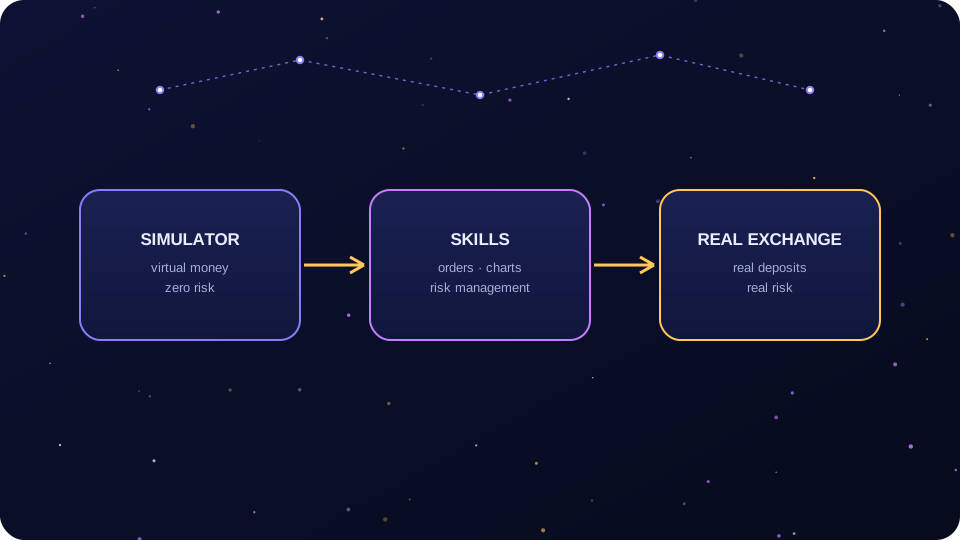
- Master the simulator. Trade in CryptoCosmic with rules, not vibes: fixed position sizes, a stop-loss on every trade, a journal of why you entered. Give it one to two months. The trading guide lays out the drills.
- Open an account on a regulated platform. When the discipline holds, sign up with a regulated live trading platform, complete KYC, and switch on 2FA and address whitelisting before depositing a cent.
- Deposit small. An amount you could lose without flinching. The first weeks with real money are about managing your own psychology, not returns — real losses hurt in a way the simulator never simulated.
- Run one full withdrawal as a drill. Before you care about profits, withdraw a tiny amount end-to-end: pick the asset, match the network, verify the address, wait out the confirmations. Do it once with 20 dollars so you never fumble it with 2,000.
That last step is the one almost everyone skips and later regrets. A withdrawal you have rehearsed is a routine; a withdrawal you attempt for the first time under stress is where network mix-ups happen.
Our Verdict
How do you withdraw money from Crypto Cosmic? You do not, and you never will — the developer says so in its own Terms, and every balance in the app is virtual by design. That is not a flaw; it is the entire point of a risk-free simulator. What deserves your anger is the ecosystem of fake payout portals, fee scams and seed-phrase phishers built on this search query: nothing that promises a CryptoCosmic payout is real. Take the skills out of the game — they are the only withdrawable asset — then use a regulated platform, match your networks, guard your seed phrase, and rehearse your first withdrawal while the stakes are tiny. Starting from zero? Install the app the safe way and treat every session as training for the day the money is real.
Frequently Asked Questions
Can I withdraw money from Crypto Cosmic?
No. CryptoCosmic is a trading simulator, and its official Terms state the game "does not contain any real-world cash or real cryptocurrency mechanics and is fully virtual". Every coin and profit in the app is game currency with no cash value. There is no withdrawal feature, no payout system and no way to convert the balance — anyone claiming otherwise is running a scam.
A website promises CryptoCosmic payouts — is it real?
No, it is a scam, without exception. The developer has no payout system, so no site can "release" your winnings. These fake portals follow one script: show you a balance, then demand a "fee", your card details or your seed phrase before paying out. Nothing arrives. The only official site is cryptocosmicapp.com, which has no login, no dashboard and no withdrawal page.
How do withdrawals work on real crypto exchanges?
You verify your identity (KYC), secure the account with 2FA, then choose the asset, paste the destination address, select the blockchain network and confirm — usually with a code or passkey. The network fee is deducted from the amount you send. Processing typically takes minutes to a few hours, and a first or unusually large withdrawal can trigger an extra compliance review.
What network should I choose when withdrawing?
Always the same network the receiving address uses — this is the one rule that protects your money. USDT, for example, exists as ERC-20 on Ethereum and TRC-20 on Tron; sending on the wrong one usually means the funds are lost or recoverable only through a slow, uncertain support process. Check the recipient side first, match it on the sending side, and send a small test amount to any new address.
Why is my withdrawal pending on a real exchange?
Usually for a boring, legitimate reason: exchanges batch withdrawals to save fees, congested networks slow confirmations, and compliance checks under MiCA and the Travel Rule can hold a first or large withdrawal for manual review — sometimes longer on weekends. Check the transaction status in your account and on a block explorer. Never pay anyone who says a fee will "unstick" a pending withdrawal; that is a scam.
Is there a minimum withdrawal amount?
On real exchanges, yes — every platform sets a minimum per asset and per network, mainly so the network fee does not eat the entire transfer. The exact figure varies by platform and changes over time, so trust the number shown on the withdrawal screen itself. In CryptoCosmic there is no minimum because there are no withdrawals at all: the balance is virtual game currency.
Can I at least transfer my CryptoCosmic coins to another app or wallet?
No. The virtual coins exist only inside the game — there is no blockchain behind them, no wallet address, no export function, nothing to transfer. The one thing that leaves the app with you is trading skill: chart reading, position sizing and risk management all carry over directly to a real platform, which is exactly what a simulator is for.