Let's kill the myth in the first paragraph. There is no crypto cosmic wallet in the real sense of the word. CryptoCosmic Trading Simulator — the Android app with 5M+ downloads and a 4.6★ rating from roughly 224,000 reviews, according to the official Google Play listing — is a game. The official Terms of Use, published by Smarteq Technology FZE LLC on cryptocosmicapp.com, say it in plain legal English: the game "does not contain any real-world cash or real cryptocurrency mechanics and is fully virtual."
We have audited crypto platforms since 2017, and we rarely get to write a sentence this clean: your CryptoCosmic balance has no blockchain address, no private key, no Seed Phrase and no withdrawal function — because there is nothing real to store. Every coin in the app is a number in a game database, a score dressed up as a portfolio.
That answers the search query. The rest of this page covers what the in-app balance actually is, why the confusion exists, and — the part that will matter later — how real wallets work when you graduate from the simulator.
What the "wallet" inside CryptoCosmic actually is
Open the app and you will see something that looks like a portfolio: virtual Bitcoin, Ethereum, USDT and other assets, priced with real-time market data per the official listing. It behaves like an exchange account balance — you "buy" on a candlestick chart and your paper profit or loss updates live. The whole mechanic is covered in our how to trade on CryptoCosmic guide.
Under the hood, though, it is a virtual portfolio, the same concept brokers have used for decades under the name paper trading or demo account. The prices are real; the money is not. Three technical facts make this obvious:
- No deposit address. A real wallet or exchange account gives you a blockchain address to receive funds. CryptoCosmic has none, anywhere in the app — you cannot send BTC to it.
- No private keys or Seed Phrase. Real crypto ownership is cryptographic. The app never generates keys because there are no on-chain assets to control. There is no
KYCeither — a PEGI 3 educational game does not need your passport. - No withdrawal function. We dissected this in detail in our withdrawal truth article: there is no cash-out button because the Terms rule out real-money mechanics entirely.
Calling this a "wallet" is like calling your Monopoly cash a bank account: the interface borrows the look of a trading terminal, but the resemblance ends at the pixels.
Why people search for a crypto cosmic wallet anyway
The confusion is manufactured. Three forces feed it.
First, the app looks real. Live prices, an order ticket, a portfolio screen — a newcomer can reasonably assume there is a wallet with real coins behind it. There is not, and the developer never claims otherwise; the official tagline calls it "a virtual simulator that lets you experience the thrill of crypto trading without risking real money."
Second, clone sites. Search results around any popular crypto app attract parasites. We have seen pages promising a "Crypto Cosmic wallet login", a "CryptoCosmic web dashboard", even "CryptoCosmic payout portals". Remember: the official website has exactly three pages — Main, Privacy Policy and Terms of Use. No login, no dashboard, no wallet interface. Our login and sign-up guide shows what the genuine entry flow looks like.
Third, keyword mashing. "Crypto" plus "wallet" is a high-value search combination, so low-effort sites blend the app name into generic wallet content and hope you click.
Scam warning. Any website offering a "Crypto Cosmic wallet login", a "CryptoCosmic wallet app" for iOS or desktop, or — worst of all — asking you to enter a
Seed Phraseto "sync" or "verify" your CryptoCosmic balance is a fraud. Full stop. The game has no real wallet, no web login and no iOS version. A seed phrase entered on such a site goes straight to a thief who will drain whatever real wallet it belongs to. Close the tab and report it.
No real wallet is a feature, not a flaw
Here is the take most reviews miss: for a learning tool, no real wallet is the best security property CryptoCosmic could have.
- Nothing to hack. Exchanges get breached; hot wallets get drained; phishing kits harvest seed phrases every day. A simulator holding zero real assets is a worthless target.
- Nothing to lose. Beginners blow up their first account — it is close to a law of nature. In a virtual portfolio that costs a bruised ego; in a real one, rent money.
- Nothing to regulate away from you. No KYC files waiting to leak, no frozen withdrawals, no jurisdiction drama — a PEGI 3 game on Google Play does not carry those risks.
After years of documenting platform failures, "fully virtual" reads to us less like a disclaimer and more like armor. If you want the broader picture of what the app is and is not, start with what is CryptoCosmic.
Real crypto wallets, explained by an auditor
Now the part that will actually matter when you leave the simulator. A crypto wallet does not store coins — coins live on the blockchain. A wallet stores keys: the cryptographic credentials that prove the coins are yours and let you move them. Whoever holds the keys holds the money. Everything else is detail.
Custodial vs non-custodial — on fingers
A custodial setup — a crypto exchange account — is like a bank. The exchange holds your keys, you hold a login and password. Forget the password? Support resets it after you verify your identity through KYC. Convenient, familiar, and it comes with the bank trade-off: the institution controls the money, can freeze it, and if the institution fails, you stand in a creditors' queue.
A non-custodial wallet is your personal safe. You — and only you — hold the keys, in the form of a 12- or 24-word Seed Phrase generated when you create the wallet. Nobody can freeze your funds, censor your transaction or "reset your account". The flip side is absolute: lose the seed phrase and no support desk exists. There is no "forgot my seed" button, no hotline, no recovery email. The math that makes your coins unstealable also makes them unrecoverable.
Hot vs cold storage
Independent of custody, wallets split by internet exposure. A hot wallet (mobile or browser app) keeps keys on a connected device — convenient for daily use, exposed to malware and phishing. A cold wallet keeps keys offline. For serious sums, that means a hardware wallet: a dedicated device that signs transactions internally so the keys never touch your phone or laptop. Our working rule: pocket money can live hot; anything you would hurt to lose goes cold, and amounts above a monthly salary belong on hardware.
The four "wallets" side by side
| Storage type | Who holds the keys | If you lose access | Main risk | Best for |
|---|---|---|---|---|
| CryptoCosmic virtual portfolio | Nobody — no keys exist | Reinstall, keep playing | None (no real assets) | Learning charts and order logic risk-free |
| Custodial exchange account | The exchange | Password reset via KYC support | Platform hack, freeze or insolvency | Buying, selling, active trading |
| Non-custodial hot wallet | You (keys on your device) | Restore from Seed Phrase — or lose everything | Phishing, malware, seed leakage | Everyday self-custody, DeFi, small sums |
| Hardware (cold) wallet | You (keys offline in a device) | Restore from Seed Phrase on a new device | Losing seed backup, physical coercion | Long-term storage of serious money |
Seed phrase safety — the non-negotiables
Seed phrase rules, foolproof edition. Never photograph it. Never type it into a phone note, password manager, email draft or cloud file — no digital copy, ever. Never enter it on any website, and never share it with anyone, including "support agents": real support never asks for it, only thieves do. Write it on paper by hand, store two copies in separate physical places, and for amounts that matter, stamp it into a steel plate — paper burns, metal does not. Anyone who has these words has your money.
Wallets in 2026: smart accounts, passkeys, MiCA
The seed-phrase-or-death model is finally softening. Account abstraction (smart wallets) lets a wallet be a programmable contract: spending limits, social recovery through trusted contacts, gas paid in stablecoins. Passkey login now guards several mainstream wallets. And in the EU, MiCA forces licensed custodians to segregate client assets and disclose how they hold them, making regulated custody measurably safer than in the wild years. Good progress; none of it repeals the golden rule. Whoever controls the keys — a contract, a passkey, a phrase — controls the funds.
How to pick your first real wallet — the auditor's checklist
When the time comes, do not pick by ad budget. Run any candidate through this list:
- Open source? Public code can be inspected by anyone. Closed-source wallets ask for blind trust — the exact thing crypto was built to remove.
- Audit history? Look for independent security audits, recent ones, with reports you can actually read. "Audited" in a marketing banner with no linked report counts as no.
- Track record? Years in production without a key-leaking incident beat any feature list.
- What does it log? Read the privacy policy: does the wallet route requests through its own servers, tying your IP address to your balances? Prefer one that supports your own node or a privacy-respecting backend.
- Backup and recovery options? Standard seed phrase (interoperable — you can restore in another wallet) beats proprietary cloud backup you cannot control.
- Genuine download source? Only official app stores or the verified official site. Fake wallet apps are a top theft vector — the same clone plague that produced fake "Crypto Cosmic wallet" pages.
Good news for beginners: you do not need to solve wallets on day one. Learn to read a candlestick chart and place orders while your balance is fictional; adopt real key management only when real money enters the picture. CryptoCosmic is free on Google Play — see our download guide for the genuine link and the fakes to avoid.
From simulator to self-custody: the sane path
Here is the progression we would hand a younger sibling, in order and without skipped steps:
- Practice in the game. Use the virtual portfolio to make every classic mistake for free: overtrading, ignoring a
stop-loss, revenge-trading a red candle. - Build rules, not vibes. Position sizing, risk per trade, a written plan. If you cannot stay disciplined with play money, real money will be worse, not better.
- Open an account on a regulated platform. When your simulated results stop embarrassing you, register with a regulated live trading platform, complete KYC, enable
2FAwith an authenticator app, and start with money you can genuinely afford to lose. - Withdraw to your own wallet. Buy a small amount, create a non-custodial wallet, back up the seed phrase on paper, and move the coins. That transfer, not the purchase, is the moment you actually own cryptocurrency. Our withdrawal guide walks through how real exchange withdrawals work.
- Scale storage with sums. The day your holdings would hurt to lose, buy a hardware wallet from the manufacturer directly. Never second-hand.
Verdict: no wallet, no problem
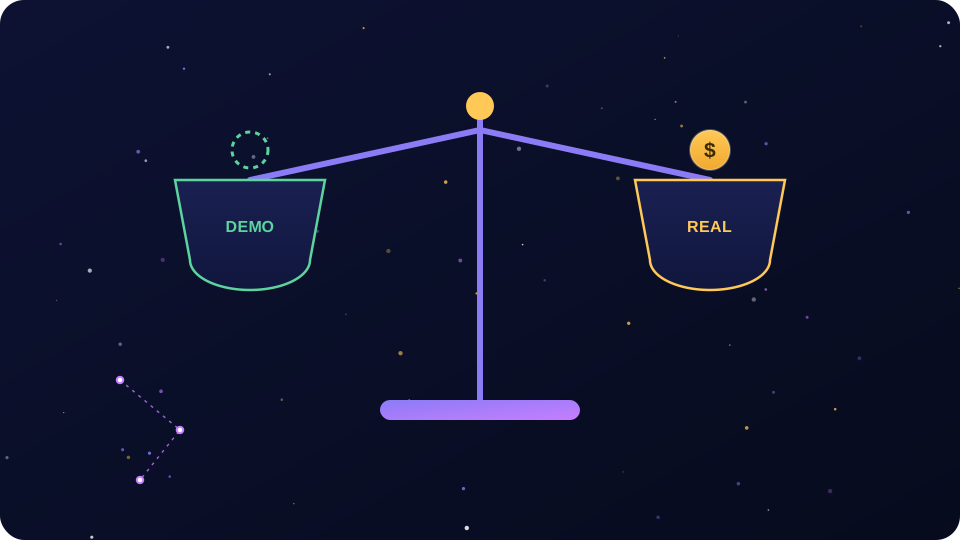
The honest summary of the crypto cosmic wallet question fits in three lines. The app has no real wallet because it holds no real crypto — the official Terms call it "fully virtual", and every technical detail confirms it: no addresses, no keys, no withdrawals. Anyone selling you a CryptoCosmic wallet login or asking for a seed phrase in the app's name is running a scam. And for a free educational simulator, that emptiness is precisely the point — you get the reflexes of trading without the attack surface of ownership.
Use the game for what it is: a flight simulator for markets. Then, when real money enters, bring the discipline you built and the wallet knowledge from this page. Keys, custody, cold storage — that is the real curriculum.
Frequently Asked Questions
Does Crypto Cosmic have a real wallet?
No. CryptoCosmic Trading Simulator has no real cryptocurrency wallet. The official Terms of Use state the game "does not contain any real-world cash or real cryptocurrency mechanics and is fully virtual." The in-app balance is a virtual portfolio — a game score with live market prices attached. There are no blockchain addresses, no private keys and no seed phrase, because there are no real coins to secure.
Can I send Bitcoin or USDT to my CryptoCosmic balance?
No, and do not try. The app never generates a deposit address, so there is nowhere to send real BTC, ETH or USDT. Any address supposedly linked to a "Crypto Cosmic wallet" comes from a scammer, and coins sent to it are gone permanently — blockchain transfers cannot be reversed. The simulator tops up your virtual balance through gameplay, missions and rewards, never through real deposits.
What is a seed phrase and why does CryptoCosmic not have one?
A seed phrase is a list of 12 or 24 words that encodes the private keys of a real non-custodial wallet — whoever knows it controls the funds, and losing it means losing access forever. CryptoCosmic has no seed phrase because it manages no real keys and no real assets. If any site or "support agent" asks for a seed phrase in connection with CryptoCosmic, it is a theft attempt.
What is the difference between a custodial and a non-custodial wallet?
Custodial means a company — usually an exchange — holds your keys, like a bank holds your money: convenient, password-resettable, but they control the funds and platform failure puts you in a creditors’ queue. Non-custodial means you hold the keys via a seed phrase, like a personal safe: nobody can freeze it, and nobody can recover it for you either. Beginners typically start custodial and move to self-custody as sums grow.
Is a "Crypto Cosmic wallet login" website legitimate?
No. The official website, cryptocosmicapp.com, has only three pages — Main, Privacy Policy and Terms of Use — with no login, dashboard or wallet interface. The game itself is Android-only via Google Play. Any web page offering a CryptoCosmic wallet login, an iOS build, a payout portal or a balance "verification" form is unofficial and almost certainly a phishing operation. Never enter credentials or a seed phrase there.
Which real wallet should I get after learning on the simulator?
Start with a well-established, open-source non-custodial mobile wallet with a published audit history and standard seed-phrase backup, downloaded only from the official store. Use it for small amounts first. Once your holdings would genuinely hurt to lose, add a hardware wallet bought new from the manufacturer. Before any of that, practice order flow in the simulator and on a regulated exchange — wallet skills matter only once real coins exist.